


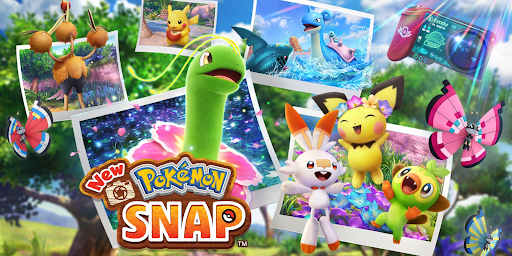
Pokémon photography fans have waited 22 years for the New Pokémon Snap to arrive. Its predecessor, Pokémon Snap, was originally released on the Nintendo 64. The classic on-rails photography game had a very fun premise, sending you on a nature safari to try and get the best photos possible of Pokémon living and interacting in their natural habitats.
The New Pokemon Snap for the Nintendo Switch is a fun follow-up to 1999 classic that resurrects the unique photo-snapping concept, while also offering a whole new region to explore and new ways to interact with Pokemon.
Welcome to the Lental Region
The storyline of New Pokemon Snap casts you as a researcher who has travelled to the Lental region to document the Illumina phenomenon, which makes Pokemon glow for unknown reasons.
The Lental region is supposedly an archipelago with multiple environments filled with Pokemon. So, to research, the Illumina phenomenon, Professor Mirror and his Laboratory of Ecology and Natural Sciences (L.E.N.S.) have set up shop in the region, and he’s sending you out to these different biomes to snap Pokemon pictures.
It’s the same setup as the original Pokemon Snap, only it’s set in a new region and with a new cast. The New Pokemon Snap places you in a protective vehicle that takes you through various courses of the game. Each course takes only a few minutes to complete. The preset track through the different areas is a fundamental part of how the game is structured.
Your goal is to take the best pictures possible across a variety of courses, from the Lental region’s nature park to tropical beaches. Each one is explored rail-shooter style and, despite sounding restrictive, it gives you the freedom to focus on taking pictures or uncovering secrets, such as alternative routes.
Every location in the Lental Region is filled with Pokémon roaming the land, in the skies, or in the waters, making it near impossible to capture them all on camera in just a single visit. You’ll find yourself revisiting courses to investigate what’s occurring behind your pod or to capture the activities of a sole Pokémon.
Snapping a Pokemon
You’re tasked with taking photos of Pokemon in each course, and you can freely snap them, with enough camera memory for several dozen Pokemon through every course. You can snap in a 360-degree, half-dome formed by the NEO-ONE vehicle, and can zoom in on every interesting sight you find.
However, angles and timing aren’t the only factors for getting the best shots. You can throw fruits to lure the Pokemon or disturb them by throwing Illumina balls to make them light up, or even play melodies to make them dance.
You receive points for each new photo you add to your Photodex, based on a number of criteria. If the Pokemon is bigger and more centred in the frame, you get more research points.
You earn more points if the Pokemon is facing you and if there are multiple Pokemon in the picture. Size and position are the most important factors in your photo score, which shows that Professor Mirror doesn’t have much respect for photographic composition and the Rule of Thirds.
Each Pokemon has four photo slots for capturing their different behaviors. You will be scored in that manner, from one star for the most common actions, to four stars, for the rarest actions. More stars mean more points, but that isn’t as important as the fact that each star has its own slot in the Photodex. This means you can keep up to four photos of each Pokemon in your Photodex, and collect four photos’ worth of research points for them.
Illumina Orbs
You can unlock Illumina Orbs gradually, as you learn more about Illumina Pokémon. They are, as the name suggests, Pokémon that glow, and the game centres around Professor Mirror’s research into this phenomenon. The plotline here serves more as connective tissue for unlocking the various courses in New Pokémon Snap.
How it works is, that if you hit a Crystabloom flower or a Pokémon with an Illumina Orb, it may cause it to perform a special behavior, which will grant your photograph a higher star category.

However, not every Pokémon you encounter is affected by the Illumina Orb, so it does involve an amount of trial and error to discover which creatures are worth targeting. Judging the distance between your target and the pool can also be difficult when throwing both Illumina Orbs and Fluffruit.
It’s easy to under or overshoot your target since you’re constantly moving. This can quickly become frustrating as you’re left to restart the course in the hope you’ll be able to both make the shot and take the photo in time.
Research Levels
The New Pokémon Snap gives each course a number of research levels, which determines which Pokémon appear and where with certain Pokémon only showing up on specific research levels or behaving differently. Some courses can also be explored during the night, which, again, leads to the discovery of a new selection of Pokémon.
Florio Nature Park, for example, cannot be found during the day in Sylveon but can be easily found once night falls. Both the Research Levels and night-time courses help maintain a sense of discovery, which ensures returning to these courses, even as you progress further, is enjoyable.
Research Levels and some of the courses can be unlocked by reaching a specific number of Expedition Points, which are earned from your photo evaluations given at the end of each course.
Expedition Points are tallied from six evaluation factors, such as which direction the subject of your photo is facing and whether it’s placed in the centre of the photograph. It’s rewarding to receive a diamond rating on a photo that has taken you multiple runs to the perfect position.
Tasks and Requests
Besides getting research points, you can fulfil dozens of requests and tasks as you play through the game. When you unlock a new course or increase a course’s research level, you will receive a series of prompts that will provide you with tasks to photograph certain things.
These are usually unique Pokemon interactions, such as snapping a Pokemon napping on another Pokemon and tend to be even harder to find than four-star poses. These special photos won’t necessarily give you more research points, but they help unlock new customization options, such as photo frames and effects.

Photos can be saved, touched up, and edited in the online photo album
You can save any of your photos, whether you submit them for scoring or not, to the in-game album. You can also edit each photo by adding stickers, frames, and filters. Furthermore, save the edited photo directly to your online photo album for sharing through the console-level sharing system. You can also upload your photos directly to the game’s servers for other players to look at and like.
If you are solely focusing on unlocking every course, you could probably “finish” New Pokemon Snap in around eight hours. However, that’s not how you play the game. It’s a photo adventure that invites you to keep coming back and finding new things in each area, steadily adding more and more as you play. The requests add even more tasks. The game is loaded with things to see if you keep at it and try to increase your research levels as much as possible.